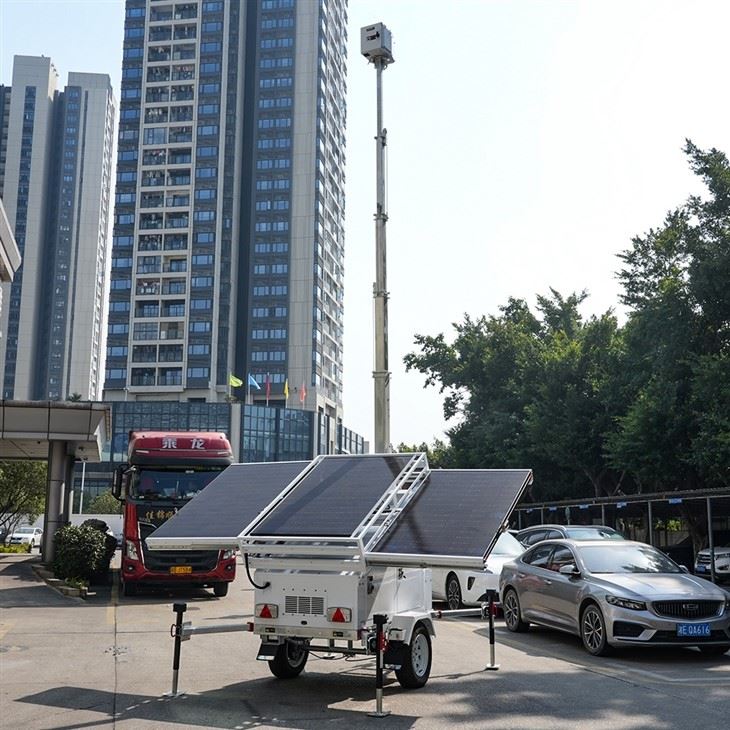
 2/3/5 × 450W PV7m Mast4G / Wi-Fi
Solar Mobile Surveillance Trailer
Specify This Surveillance Trailer
Model pre-filled for your enquiry — confirm or change it on the contact page.
Solar Mobile Surveillance Trailer
Biglux Innovation Ltd (brand BIGLUX) manufactures this solar mobile surveillance trailer as a towable, solar-powered video surveillance platform for sites that have no reliable grid connection. The trailer combines a round aluminum alloy telescoping mast, monocrystalline solar panels, an onboard power system, with support for 4G/Wi-Fi communications (communications hardware to be confirmed as an option during enquiry). Because the power system travels with the mast, the unit can be positioned where cameras are needed rather than where electrical infrastructure happens to exist.
This product suits buyers who need temporary or semi-permanent video coverage: construction contractors, traffic management teams, event organizers, mining and oil operations, public security agencies, emergency response teams, and equipment rental companies. It is relevant both to organizations purchasing for their own use and to rental fleets specifying units for resale or hire.
Configuration at a glance
| Item | Specification |
|---|---|
| Mast | Round aluminum alloy telescoping mast; 7 m standard, 9 m optional |
| Solar options | High-efficiency monocrystalline panels: 2×450W, 3×450W, or 5×450W |
| Weight note | The 3×450W HiSTAR version is listed at under 1700 kg total unit weight |
| Communications | Supports 4G / Wi-Fi (hardware option to be confirmed); remote camera access via mobile phone or computer |
| Maintenance design | Double-door structure allows battery and system maintenance without opening the control side door while the system runs |
Telescoping mast: 7 m standard, 9 m optional
The mast is a round aluminum alloy telescoping design. Aluminum alloy keeps the mast structure light relative to its extended height, which matters on a towable platform where total unit weight affects towing and positioning. The standard deployed height is 7 m; a 9 m option is available for applications requiring greater elevation.
Mast height affects how much area a camera can observe and how well the camera position clears obstructions such as parked vehicles, stored materials, temporary fencing, or site equipment. When specifying, consider the height of surrounding obstacles, the required viewing distance, and the wind exposure of the deployment location. The mast is a structural element of the trailer, so height selection should be made together with the solar configuration and camera payload rather than as a separate decision.
Solar power options: 2×450W, 3×450W, or 5×450W
The trailer uses high-efficiency monocrystalline solar panels. Three configurations are offered:
- 2×450W — the entry solar configuration; check the panel configuration against the connected load and the solar resource at the deployment site.
- 3×450W — the mid configuration. The 3×450W HiSTAR version is listed at under 1700 kg total unit weight.
- 5×450W — the largest solar configuration, for installations where more generation capacity is needed to support the connected load.
Each configuration is a different product build with its own weight and balance characteristics. The 3×450W HiSTAR figure of under 1700 kg applies only to that version; it should not be applied to the 2×450W or 5×450W builds. Panel configuration should be selected against the actual connected load — camera count and type, communications equipment, and any auxiliary devices — plus the solar resource at the deployment latitude and season. BIGLUX does not state runtime guarantees for these configurations; the correct approach is to match generation and battery capacity to a measured or estimated load profile.
Communications and remote access
The trailer supports 4G and Wi-Fi communications. Camera feeds can be accessed remotely from a mobile phone or a computer, so operators do not need to visit the site to check the view. This is the core operational advantage of a connected surveillance trailer: Remote access lets operators check camera views without visiting the site.
When specifying communications, confirm the cellular bands and coverage at the deployment site, whether a local Wi-Fi bridge is required, and how camera streams will be routed to your monitoring platform. If the site has weak cellular coverage, this should be identified before ordering because it affects both hardware selection and camera settings such as resolution and frame rate.
Maintenance-friendly structure
The trailer uses a double-door structure. This allows battery and system maintenance to be carried out without opening the control side door while the system is running. The double-door layout separates the battery/system area from the control compartment for service access; confirm the maintenance procedure for your configuration during enquiry.
Suitable applications
- Outdoor parking lots — coverage of entrances, exits, and rows without trenching for power or network cable.
- Construction sites — monitoring of plant, materials, and site perimeter during works and out of hours.
- Traffic monitoring — temporary observation points at roadworks, diversions, and incident locations.
- Public security — rapid deployment of camera coverage at short-notice locations.
- Sports and events — temporary surveillance for stadia, circuits, festivals, and gatherings.
- Mining and oil — coverage of remote pads, access roads, and equipment yards beyond grid reach.
- Emergency response — surveillance at incident scenes and temporary staging areas.
- Equipment rental — a towable, self-powered asset that can be redeployed between customers.
What to confirm before ordering
- Solar configuration. Choose 2×450W, 3×450W, or 5×450W based on the connected load and the solar conditions at the deployment site. Note that the under-1700 kg figure applies only to the 3×450W HiSTAR version.
- Mast height. Decide between the 7 m standard mast and the 9 m option based on required camera elevation and site obstructions.
- Camera and communication requirements. Confirm camera count and type, whether 4G or Wi-Fi (or both) is needed, the cellular coverage at the site, and how feeds will be delivered to your monitoring platform.
- Towing and siting. Confirm the towing vehicle and route, and the ground conditions at the deployment point. Towing regulations vary by jurisdiction, so verify local requirements before transport.
Certificates are available upon request. BIGLUX has more than 10 years of experience in the mobile solar industry and manufactures solar light towers, solar CCTV towers, solar trailers, mobile energy storage, and telescopic masts.
Specify This Surveillance Trailer
Contact BIGLUX to specify this solar mobile surveillance trailer for sale:
- WhatsApp / WeChat: +86 18128807281
- Hot line: +86 18818785601
- Email: sales@solarlighttowerpro.com
- Head office: Building 6, No. 34, Guanghui Rd, Longteng Community, Shiyan Street, Bao'an District, Shenzhen, China
Surveillance trailer: what's listed
- Standard: 7 m aluminium telescoping mast, 4G / Wi-Fi remote access, double-door service layout
- Options: 2 / 3 / 5 × 450W PV; 9 m mast
- To confirm: battery configuration, camera load, maintenance procedure
Specify This Surveillance Trailer
Certificates available upon request.